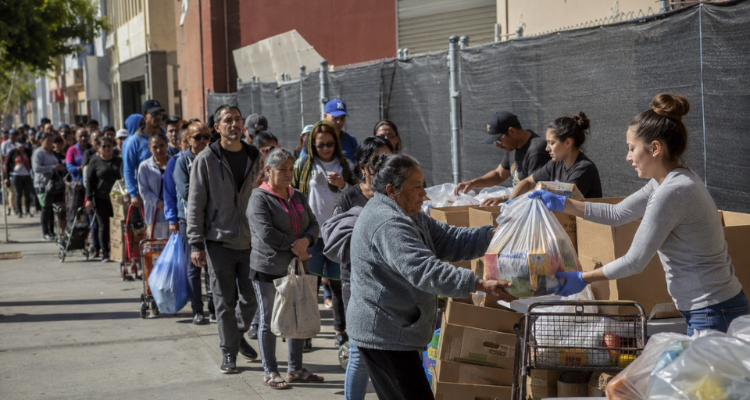
The nation’s largest state is bracing for the hardest blow to its food assistance program in decades. Starting June 1, 2026, approximately 1 million Californians will become subject for the first time to the new work requirements included in federal law H.R. 1. Of those, state officials estimate that roughly 665,000 people will not meet the requirements or qualify for an exemption — meaning they will lose access to CalFresh — California’s SNAP program — three months after being assessed. That translates to approximately 108,000 people cut off every month throughout that period.
The impact in California will be historic. The state currently has more than 5 million CalFresh recipients, and this new wave of cuts comes on top of those that already began on April 1, when thousands of immigrants with legal humanitarian status — refugees, asylees, parolees, domestic violence victims, and trafficking survivors — lost their eligibility for the program.
Who is affected by the June 1 change
The new obligation applies to adults between the ages of 18 and 64 who receive CalFresh, do not have dependents under 14 in their care, and do not have a medically certified disability. This group must demonstrate at least 80 hours of work activity per month — equivalent to 20 hours per week — through paid employment, volunteering, or participation in approved training programs.
Until now, California had been applying the requirements gradually thanks to the use of accumulated banked months, which delayed the first large-scale cutoffs to June 1 instead of May 1. However, that buffer has run out, and the California Department of Social Services (CDSS) has confirmed that as of that date, cuts will be applied without further delay.
A double blow: work requirements and immigrant eligibility loss
California is one of the states with the highest proportion of immigrant recipients in its food assistance program. Since April 1, 2026, H.R. 1 has already eliminated eligibility for numerous groups of immigrants with legal status: refugees, asylees, humanitarian parolees, certified domestic violence victims, and trafficking survivors, among others. Eligibility is now maintained only for lawful permanent residents, beneficiaries of the Compact of Free Association (COFA), and a few other specific groups.
The California Association of Food Banks estimates that these two changes combined — the loss of immigrant eligibility and the new work requirements — could leave hundreds of thousands of additional families without CalFresh access throughout 2026, placing unprecedented pressure on food banks and community organizations across the state.
The financial problem: California could pay up to 7 times more
Beyond the impact on recipients, California also faces a financial crisis tied to the program. H.R. 1 introduced a penalty system for states with high SNAP payment error rates. Starting in October 2027, states with error rates at or above 6 percent will be required to cover a share of benefit costs, up to a maximum of 15 percent for those exceeding 10 percent.
California historically has one of the highest error rates in the country. Independent analysts and state officials — including in New York, which faces a similar problem — have warned that some states could end up paying up to seven times more than they currently do in SNAP co-financing if they fail to reduce their error rates before the new system kicks in.
What you can do if you receive CalFresh in California
If you receive CalFresh in California and are between 18 and 64 years old without dependents under 14, act before June 1. Find out whether you are subject to the work requirements by contacting your county’s social services department. If you are already working, in training, or volunteering, make sure your agency has up-to-date documentation of your activity on file. If you believe you may qualify for an exemption — due to a disability, pregnancy, or another reason — apply for it now. The time left to act is measured in days, not weeks.