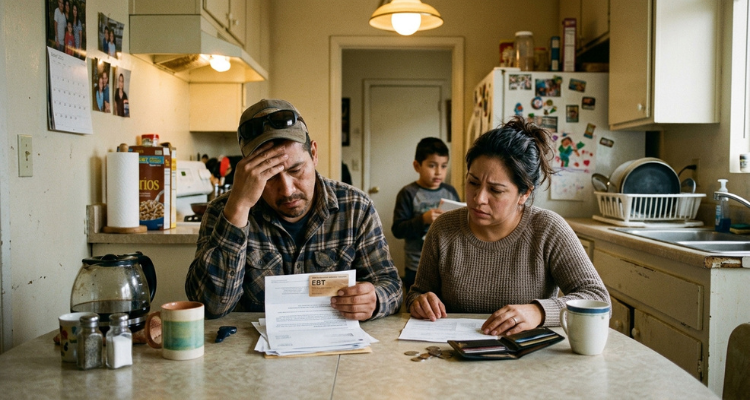
Of the more than 4 million people who have lost access to the SNAP food assistance program since July 2025, a significant share belongs to the Latino community. An analysis by UnidosUS, the largest Hispanic civil rights organization in the United States, found that approximately 1.3 million Latinos may have lost SNAP access between February 2025 and February 2026 — representing nearly one third of the program’s total decline during that period.
The figure is part of a broader picture that continues to deteriorate. According to the AP, the number of SNAP participants dropped from 42.83 million in January 2025 to 38.55 million in January 2026 — a difference of nearly 4.3 million people in twelve months. The U.S. government itself linked the acceleration of this decline to the implementation of the «One Big Beautiful Bill» law, signed by President Trump in July 2025, which redefined the conditions for accessing the program.
Why the Latino community is especially exposed
The loss of benefits has not hit all groups equally — and the Latino community is among the most vulnerable in this context for several reasons. First, Latinos make up a large share of workers in sectors such as hospitality, construction, agriculture, and services — jobs frequently characterized by employment instability, low wages, and difficulty documenting work hours, which is now essential to meet SNAP’s new work requirements.
Second, a portion of the Latino community consists of immigrants with legal status — refugees, humanitarian parolees, domestic violence victims — who since April 1, 2026 have directly lost their eligibility for the program. While most SNAP recipients are American citizens or permanent residents, this subgroup has been among the first to feel the cuts.
Third, language barriers and lack of information make it harder for many Latino families to know their rights, understand how to apply for exemptions, or follow exactly what has changed in the program rules. Many are losing SNAP not because they have stopped meeting the requirements, but because they do not know how to prove that they do.
The key question: can you get your benefits back?
If you are Latino and have recently lost access to SNAP, the first thing to know is that the loss may not be permanent. Here are the most important steps you can take right now:
Check whether you qualify for an exemption. If you have a physical or mental disability — even if you are not currently receiving any disability benefit —, if you are pregnant, if you care for a child under 14 or a person with a disability, or if you are enrolled in a job training program, you can apply for an exemption from the work requirements. Call your state’s SNAP agency and ask specifically about available exemptions.
Verify that your case is still active. Many people have lost SNAP due to administrative errors — forms that did not arrive on time, documentation that was not processed, or simply because nobody told them they needed to renew. Call your state agency and ask them to check the current status of your case file.
Look for help organizations in your community. Organizations such as UnidosUS, Latino community centers, food banks, and free legal services groups can help you understand your rights, complete the application, and file an appeal if you have been wrongly excluded.
October brings new changes that will affect every state
The situation may become more difficult starting October 1, 2026. From that date, states will have to cover 75% of SNAP administrative costs, up from the current 50%. This cost shift may lead some states to tighten their eligibility processes, reduce the staff handling cases, or further restrict access to the program.
The good news is that maximum SNAP amounts are increasing by 2.9% starting October 1 — meaning those who continue receiving benefits will see a small increase on their EBT card. For a family of four, the maximum rises from $994 to $1,023 per month.
If you receive SNAP or believe you may be eligible, do not wait until October to act. Contact your state’s SNAP agency this week, check the status of your case, and make sure all your documentation is in order before the new changes take effect.