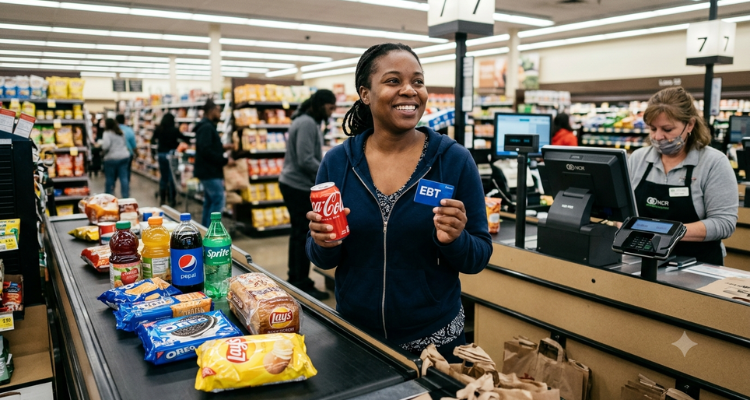
On June 22, 2026, federal Judge Amy Berman Jackson of the U.S. District Court in Washington D.C. issued a landmark ruling: the U.S. Department of Agriculture (USDA) overstepped its legal authority when it approved the pilot programs allowing states to restrict what products could be purchased with SNAP benefits. The ruling, handed down in the case Aragon v. Rollins, immediately invalidates the restrictions approved in Colorado, Iowa, Nebraska, Tennessee, and West Virginia, and halts the ban Tennessee had scheduled to take effect on July 31.
In practical terms: if you receive SNAP in one of those five states, you can continue buying sodas, energy drinks, and candy with your EBT card, exactly as before. The restrictions have no legal validity and point-of-sale terminals must not block those purchases.
The judge’s argument: only Congress can change what counts as «food» under SNAP
The heart of the ruling is a clear and firm legal principle. The federal law governing SNAP establishes a specific definition of what qualifies as eligible «food» under the program. That definition, according to Judge Jackson, can only be changed by Congress — not by the USDA through administrative approvals.
The USDA had relied on a legal provision (Section 17(b) of the Food and Nutrition Act) that allows the agency to develop pilot projects to improve the efficiency and administration of the SNAP program. The judge concluded that this provision cannot be used to redefine which foods are eligible or to eliminate entire categories of products from the program.
«The federal defendants and the states may have a genuine desire to improve the health of SNAP households by encouraging healthy choices at the store, and they can take lawful steps to meet those goals. But what they cannot do is violate the law and their own regulations along the way.»
— Judge Amy Berman Jackson
The judge also noted that the pilot projects approved by the USDA lacked the evaluative rigor that the law itself requires for this type of experimental program: they had no solid evaluation methodologies, did not adequately measure whether restrictions were improving recipient health, and did not include safeguards to minimize harm to participants, retailers, or states.
What this means for the 23 states with approved restrictions
The ruling directly invalidates the restrictions in the five plaintiff states, but its reach goes further. The USDA had already approved similar waivers in 23 states, and several more had pending applications. The court’s decision establishes that the legal mechanism used to approve all those waivers is invalid — opening the door for recipients in other states with active restrictions to file similar lawsuits or request that their restrictions be reviewed.
However, it is important to be clear that the ruling does not automatically strike down restrictions in the other 18 states where they are currently in force — such as Texas or Florida. Those restrictions remain legally active for now. What the ruling does is establish a very clear legal precedent: the USDA does not have the authority to approve these bans, and any similar lawsuit in other states would have strong legal footing.
The government’s reaction: appeal and political battle
Agriculture Secretary Brooke Rollins reacted sharply to the ruling, calling the judge an «activist» and announcing the government will keep fighting for the restrictions. «An activist judge just blocked our commonsense restriction on using SNAP benefits for soda and junk,» she posted online. «SNAP is for food — not sugar bombs fueling obesity, diabetes, and skyrocketing healthcare costs for low-income families.»
The administration has the option to appeal the ruling to the U.S. Court of Appeals for the D.C. Circuit. If it does, the restrictions in the five affected states could remain suspended during the appeal process — though that is not guaranteed and would depend on whether the appeals court grants a stay.
What does not change: work requirements remain in effect
The June 22 ruling only affects restrictions on which products can be purchased with SNAP. It has no impact on the work requirements under H.R. 1, which remain fully in force in every state. If you are between 18 and 64 years old, do not have dependents under 14, and do not have a certified disability, you are still required to document at least 80 monthly hours of work activity to keep your benefits beyond three months.
For millions of SNAP recipients across the country, this ruling is a partial but significant victory. It shows that courts can act as a check when the federal government oversteps its authority, and that the legal rights of SNAP recipients carry real weight. The battle, however, is far from over.